
What is an investment strategy?
Planning for retirement involves the setting of investment goals. To give yourself the best chance of achieving your investment goals, you need to design an appropriate investment strategy. An investment strategy outlines the way in which the investment goal will be met and is informed by factors such as:
- The amount of capital required
- Period of time over which the investment goal needs to be met
- Required rate of investment return
- The acceptable level of investment risk
- Required level of liquidity
- Tax implications
Formulating an investment strategy involves decisions regarding the investment products to be used, as well as the mix of asset classes. However, before embarking on the development of an investment strategy, it is important to understand a few key investment principles.
Time, risk and return
The cornerstone of investing is the relationship between time, risk and return. In order to achieve a specific rate of return, you have to accept a certain amount of investment risk. The higher the return required, the higher the level of risk. However, the higher the risk, the greater the potential movement in the value of your capital in the short-term.
However, by investing over a longer period of time, the risk associated with capital movements is reduced, i.e. returns are smoothed. Therefore, the higher the required rate of return, the longer the time period required to reduce the investment risk.
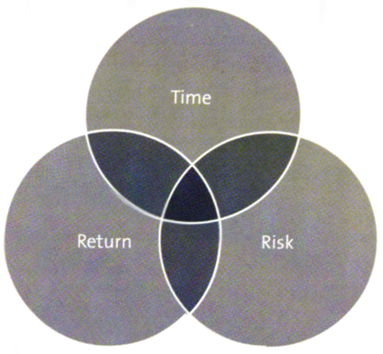
It is therefore important to understand the relationship between time, risk and return when developing your investment strategy. These elements will impact on the investment strategy applied during the wealth creation and wealth consumption stages of retirement.
The need for real returns
The constant rise of living expenses, measured by consumer price inflation (CPI), causes a continuous reduction in the value of money. It is therefore important that you grow your wealth by more than inflation. The following table provides an example of the rate of loss of purchasing power of money at different rates of inflation over time.
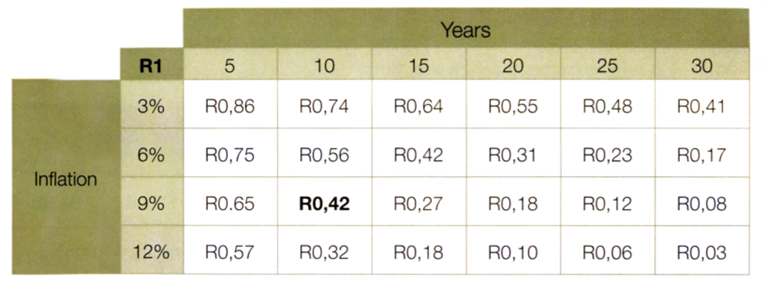
For example, every R1 that you have will be worth only 42 cents in 10 years at an inflation rate of 9%. Put in another way, whatever costs you R1 today will cost you approximately R2,38 in 10 years’ time at 9% inflation. This example illustrates how important it is to have an investment strategy that will allow your capital to grow by more than inflation.
The graph illustrates the need to grow your money in real terms when it comes to saving for retirement. By growing your investment by 5% above inflation, you will be able to replace every R100 of your final salary with R72 of income at retirement. However, if you only grow your money in line with inflation, you will only be able to replace every R100 of our final salary with R26 of income at retirement.
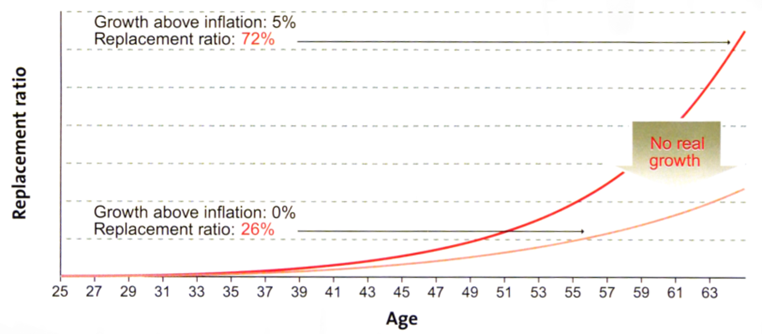
(Figures shown in the graph assume an investment period of 40 years (25 to 65), a 10%
contribution rate, the contribution growing at 7% per annum and inflation of 6%)
The power of compounding
Whereas inflation erodes the value of money over time, the principle of compounding offers a powerful countermeasure. Compounding can also be explained as the effect of accumulating growth through the reinvestment of income (e.g. interest and dividends) earned. The following table illustrates the positive impact of compounding on the value of money at different rates of return over time.
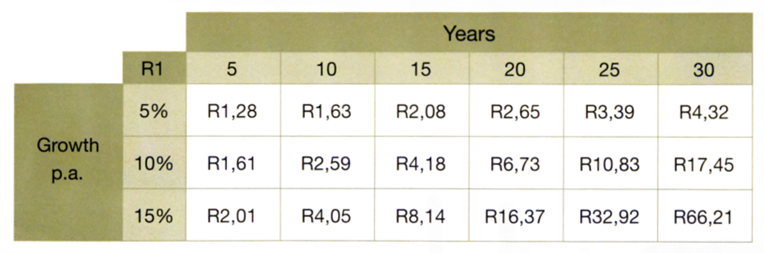
For example, every R1 invested will be worth R2.59 at an annual growth rate of 10% over a period of 10 years. This example illustrates the benefits of exponential growth that can be achieved by reinvesting investment income as part of your investment strategy.
Portfolio diversification
As with the concept of time, portfolio diversification also aims to provide a mechanism to manage and reduce investment risk. Portfolio diversification refers to investing in various asset classes that behave differently under varied market circumstances. It is, therefore, important to find the most appropriate mix of asset classes (i.e. equities, fixed interest, property and cash) that will provide the optimum combination of risk and return required.
In addition to asset class diversification, geographic and currency allocation provides an additional source of diversification. By investing in offshore markets, investors are able to avoid single country risk and the limitation of a concentrated South African stock market.
Asset allocation
Asset allocation refers to the mix of different asset classes with the aim of achieving a specific investment outcome. The main asset classes most commonly used in developing an investment strategy are cash, bonds, property and equities.
When planning for retirement, the two distinct objectives of wealth accumulation and wealth preservation need to be met depending on your life stage. These two objectives require a vastly different approach in terms of asset allocation.
Accumulating wealth involves the objective of growing your investment capital. As illustrated below, the growth of capital is achieved by predominantly investing in riskier asset classes such as property and equities. These asset classes offer the highest potential for capital growth required for growing your retirement capital and beating inflation.
However, this potential return is associated with higher investment risk in the short-term.
Therefore, these asset classes are more suited to a long-term strategy. Adding additional asset classes such as cash and bonds can be used to reduce investment risk through portfolio diversification.
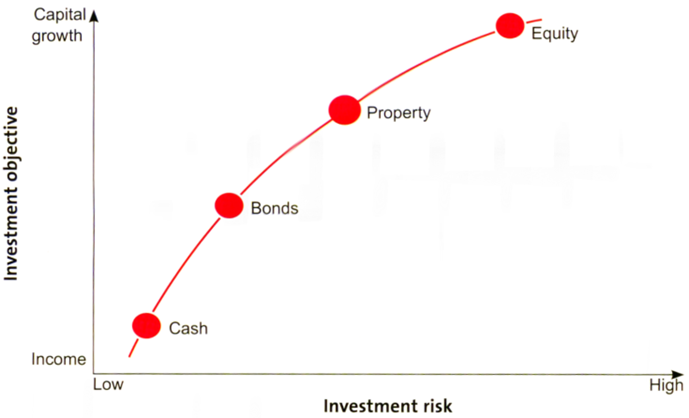
During retirement the investment objective shifts to retirement capital preservation as you begin to take a regular income. To ensure that your retirement capital lasts for as long as possible, a healthy level of stability is required in your investment portfolio. In order to achieve this, lower risk asset classes such as cash and bonds are generally more prominent in the asset mix. Cash and bonds are more stable in the short- to medium term and also serve to provide regular income in the form of interest.
Depending on the amount of income required as the percentage of your retirement capital, a greater or lesser focus on capital preservation is required. The higher the income taken as a percentage of your capital amount, the greater the need to preserve capital.
Therefore, the higher the income need, the greater the allocation to a safe asset class such as cash.
Even though the focus during retirement is on capital preservation, the risk posed by the constant rise in the cost of living cannot be ignored. It would, therefore, be appropriate to allocate a healthy portion of the investment portfolio to asset classes such as property and equity.
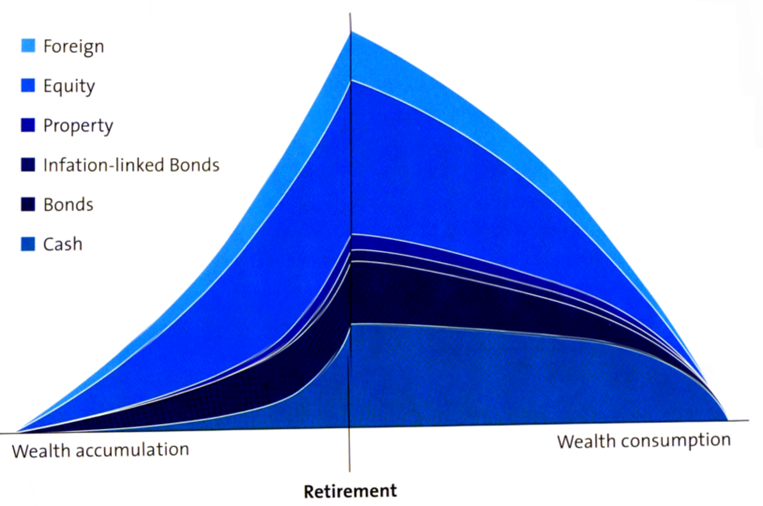
The graph illustrates the typical asset allocation profile of an investor selecting a living annuity for retirement income through the wealth accumulation and consumption phases.
The asset allocation for compulsory retirement savings is subject to legislation governing retirement funds (Regulation 28 of Pension Funds Act). This requirement states that retirement investments may not hold more than 75% of assets in equities.
Transitioning into retirement
A common mistake made when planning for retirement is that the investment strategy is designed around the date of retirement. The retirement date is worked towards as a definitive point after which a completely new strategy is devised for the retirement years. The result is that your retirement capital ends up being invested in cash at the date of retirement. Following this strategy is correct for people looking to buy a guaranteed life annuity at retirement, if the guaranteed rates offered at the time of retirement are favourable.
However, if you are considering investing in a living annuity, where you can adjust your monthly income according to your needs, then moving to cash at retirement is not advisable. The reason for this is that you are likely to have an opportunity cost by being out of the equity market which would have provided you with the necessary growth to grow your retirement capital. You will also then be faced with the challenge of re-entering the market at the most appropriate time.
The way you can avoid having an opportunity 1055, if considering a living annuity, is to stretch your investment horizon beyond retirement. This will result in a smooth transition of your pre-retirement investment strategy as you move into retirement.
