
As you enter retirement, you need to re-assess various aspects of your personal finances and your lifestyle choices. Decisions need to be made regarding the type of retirement product you will use to receive your retirement income, as well as how that investment will be structured.
Decisions at retirement
When reaching retirement, your investments may be used to purchase a regular income, also referred to as an annuity. If you were a member of a defined contribution fund, defined benefit fund or retirement annuity fund, you are legally bound to use two-thirds of the capital to buy an annuity.
The remaining third of the capital is regarded as discretionary money and it can be used to settle debt, reinvest or buy an additional income stream. A portion of this capital payout is tax-free subject to the prevailing income tax legislation.
Some of the other decisions you will need to make, include:
- whether to delay buying an annuity or taking any pension income for now.
- where to buy it from to get the best deal- you don’t have to buy it from your current
pension provider. - what sort of annuity to buy – one just for you or one to include a pension for your
spouse or partner when you die. - whether to take a tax-free lump sum from your pension fund first.
Living in retirement
Living in retirement means a change in lifestyle which impacts on how you spend your time and the expenses associated with your activities. A point of departure will be to draw up a retirement budget that reflects the realities of your chosen lifestyle. Creating a retirement budget includes everything from essentials like food, utilities and housing, to non-essentials that make life enjoyable such as travel and entertainment. You also need to plan for unexpected expenses such as medical bills or fixing a room or replacing the car.
Having determined your monthly expenses and income needs, you will then have to match this income requirement with the retirement capital resources that you have at your disposal. This income need should then be expressed as a percentage of your retirement capital and will provide an indication of the sustainability of the lifestyle that you have envisaged. This percentage will also provide an indication of the demand that your lifestyle will place on your retirement pool and how long your capital is expected to last given certain assumptions.
Depending on the outcome, decisions will have to be made regarding a change in the expected lifestyle and/or considerations regarding entering active retirement. Consideration will also have to be given to the continuous rise of the cost of living on the purchasing power of your money.

How long will my money last?
You will start tapping from your retirement capital as soon as you stop working. The main challenge during retirement will be to make your capital last for as long as possible.
How long your capital lasts will depend on the percentage income that you draw from your investment, as well as the investment returns you achieve on your capital during retirement.
The graph below illustrates the point at which your retirement capital will peak, as well as how your ability to draw income will change. Starting with R1 million, and drawing an income of 6% that escalates with 6% each year and assuming an investment return of 5% above inflation, your investment capital will reach its maximum value at around 25 years after retirement. After 25 years, your need for income starts to overtake the rate at which your capital grows, and as a result your capital value begins to decline.
Assuming a 6% inflation rate, the red line indicates that your income will remain constant in real terms throughout the 25 years. This indicates the need to increase your annual income by at least 6% in order to maintain your standard of living.
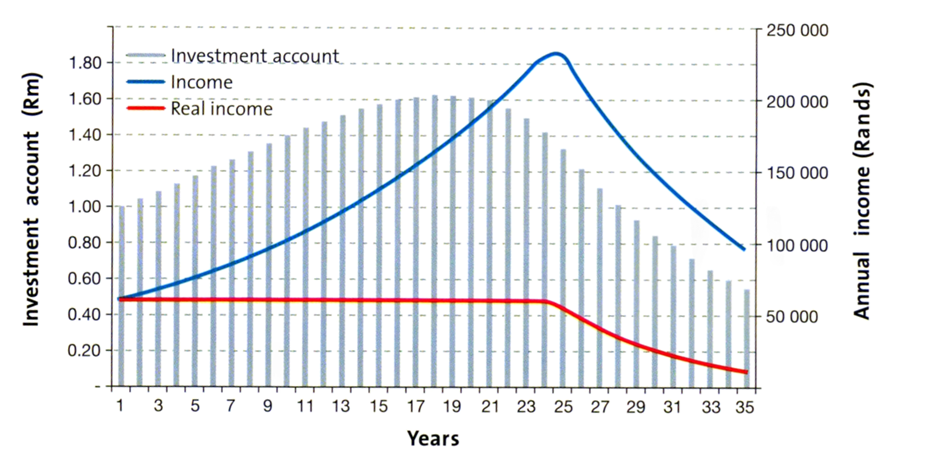
When determining how long your money will last, you therefore need to consider your consumption rate, the level of returns, as well as the rise in the cost of living (i.e. inflation).
To further illustrate the impact of inflation on the purchasing power of your money, an income of R1000 per month will half over a period of 11 to 12 years at an annual inflation rate of 6%.
Typical contributors to retirement capital
The impact of inflation on the purchasing power of your money has clear consequences for maintaining your lifestyle during retirement. It is therefore important that your retirement capital continues to work for you during retirement. A misconception exists about the importance of the contributions made to your retirement capital prior to retirement versus the importance of the investment growth achieved on your capital in retirement. The following graph illustrates how important the contribution of investment returns is in determining the size of your retirement capital.
Having determined the importance of continuing to grow your investment capital during retirement, the following table provides an indication of how long your capital is expected to last at various withdrawal rates. The table illustrates that the higher the percentage of income required, the greater the exposure required to asset classes that provide inflation-beating returns (e.g. equities). For example, if you have an income requirement of 7.5% per annum and you select a conservative portfolio consisting of 100% bonds, your retirement capital is expected to last 16 years. However, if you apply a more aggressive investment strategy using 50% equity and 50% bonds, your capital is
expected to last 21 years longer at 7.5% income.
If you have a concern about the length of time that your retirement capital will last, there are some additional aspects that need to be considered:
- If you delay your retirement, you will have more savings when you stop working completely. Your savings will also have more time to grow.
- Getting a part time job after you retire can make a big financial difference and can provide mental, physical and emotional benefits as well.
Selecting the appropriate investment income product
When selecting the appropriate retirement income product, the following factors need to be considered:
- The level of certainty required with regards to your future income
- Control in terms of level of income required
- Your financial knowledge and ability to make informed investment decisions
- Flexibility and choice in terms of the investment strategy applied
- Investment market environment
- Fees associated with the product
- Financial requirements of your spouse after you die
- Your age, as well as your physical and mental health
There are a number of options available for you to select from, with the most important aspect focused on being the level of certainty required for future income payments. The three basic choices are:
- Traditional guaranteed annuities
- Investment linked living annuities
- Composite annuities
1. Traditional guaranteed annuities
Guaranteed pensions are provided by life assurance companies. You use your savings to purchase a pension that is guaranteed for the rest of your life. Once you have purchased a guaranteed annuity, it cannot be converted to another type of annuity or be transferred to another product provider. The pension you receive is taxed at your marginal rate of income tax.
The total amount of income you receive from a traditional guaranteed annuity is based on:
Your life expectancy
If you retire young, you will receive a lower annuity than if you postpone retirement until you are older, because the life assurance company expects to pay the pension for a longer period.
Your gender
Women receive a lower pension because, on average, they live longer than men do.
Current long-term interest rates
If interest rates are high, you can expect to receive a higher pension than when interest rates are low, because the life assurance company will invest a significant amount of your savings in long-term bonds.
The type of guaranteed annuity you select
There are various options, such as a level annuity, which will provide you with the same income month after month, or an escalating annuity, which increases every year to take account of inflation.
The payment guarantees
In most cases, when you die, the pension will die with you. The only exception is if the annuity you buy is guaranteed for a fixed number of years. If you die before the guarantee period expires, your beneficiaries will receive the pension for the balance of that period. Another option will continue to pay a pension to the surviving spouse after the death of his or her partner. The guarantees on payments for a fixed period or until a surviving spouse dies, will also result in you receiving a
lower pension.
2. Investment linked living annuities
An investment linked living annuity provides members from a pension, provident or retirement annuity fund with a flexible investment vehicle from which a regular and adjustable retirement income is received.
Living annuities provide no guarantee as to the returns or performance of the underlying financial products. Such performance will depend on the financial products selected which can increase or decrease in value. Accordingly, any investment risk will be carried by you.
Since the underlying financial products are generally linked to market performance, a downturn can lead to a decline in the value of these financial products, which in turn could lead to reduced income from the living annuity in future.
The total amount of income you receive from a living annuity is based on:
Parameters set out by SARS
The current withdrawal rate of the annuity, as set out by SARS, ranges between 2.5% and 17.5% of the total capital value of the annuity per annum.
Your capital investment
The value of the annuity is initially determined by the capital investment and thereafter annually by the market value of the underlying investment options, which is normally subject to price fluctuations. The lower the withdrawal rate selected, the higher the growth potential of the portfolio.
Annual income review
You may only review and adjust the income level on the investment anniversary date, within the parameters set by SARS.
Annuity for life
The annuity fund may never be exhausted during your lifetime and is reviewed annually. If in the opinion of the financial service provider, the level of income is such that there is a danger that the underlying capital may be depleted before your death, the level of income may be reduced to ensure a continued income will be received into the foreseeable future.
Ideal investor
A living annuity is suited to individuals who:
- retire and receive proceeds from a retirement fund.
- seek to receive regular income from a flexible retirement investment vehicle.
- wish to have control of the underlying investment choices.
Features of a living annuity
Living annuities have the following features:
- Flexibility in terms of portfolio adjustments and income requirements
- Transparency related to fees, investment terms and underlying investment holdings
- Choice, which allows for the construction of a diversified portfolio from the comprehensive range of funds compliant with Regulation 28 of the Pension Funds Act
- The residual capital of a living annuity can be left to your heirs or beneficiaries as a lump sum, as an ongoing annuity or a combination of both
- A living annuity can be transferred from one product provider to another or be used to purchase a guaranteed annuity
Tax and living annuities
The annuity payment you receive is fully taxable as income with tax payable at your marginal rate on both the investment growth and the capital portions. No income tax is payable on the interest or foreign dividend earnings on the capital in your investment portfolio. No capital gains tax is payable on capital gains made within the investment portfolio, under current legislation. In the event of investors requiring a lower percentage of tax to be deducted from the annuity payment, a tax directive will have to be obtained annually from SARS.
3. Composite annuities
Composite annuities are a hybrid between a guaranteed annuity and a living annuity. With composite annuities you can use some of the retirement capital to buy a living annuity and the remainder to purchase a guaranteed annuity. Alternatively, you can delay investing in a guaranteed annuity until you are older and/or interest rates are higher so that you will receive a higher income. However, once you have purchase a guaranteed annuity with all or part of your retirement savings, you cannot convert that portion back to a living annuity. Only the living annuity portion may be converted to a guaranteed annuity.
4. Underlying investment options
Underlying investment options refer to the investment instruments available through living annuities that provide exposure to investment markets. The options offered by different financial service providers include collective investments, share portfolios, guarantees and international investments.